
Types of Pike County Deeds
Pike County land changes hands through recorded instruments. The Pike Clerk Real Estate/Property Division receives them all. A recorded deed proves a conveyance was filed, though its legal effect still depends on the instrument, the parties' authority, and the complete title record.
| Deed Type | What It Does | Common Use |
|---|---|---|
| Warranty deed | Conveys the described interest with stated covenants | Ordinary sale |
| Quitclaim deed | Transfers whatever interest the grantor holds, if any | Family transfer or title cleanup |
| Executor or administrator deed | Transfers estate property under authority | Probate administration |
| Deed under power | Documents a sale under a security instrument | Foreclosure-related transfer |
| Tax deed | Records a tax-sale conveyance subject to Georgia law | Delinquent-tax property |
Labels matter first in a deed index. A lien can encumber without transferring fee title. Pull correction deeds, plats, easements, rights-of-way, assignments, releases, and cancellations when they bear on the question, and let the instrument label guide the first reading.
Pike's Grantor-Grantee Index
The GSCCCA name search covers party type, instrument type, county, neighboring counties, search name, date range, result count, and display controls. Enter individuals as last name, first name. Search organizations separately and select Pike County.
- Find the newest deed with the current party as grantee and match the land description.
- Record execution date, recording date, grantor, grantee, instrument, and book/page.
- Search that grantor as an earlier grantee, then verify the same tract again.
- Repeat through estate, correction, tax, or forced-sale instruments without skipping them.
- Take the last reliable reference to the Clerk when the electronic chain ends.
- Grantor
- The party transferring an interest.
- Grantee
- The party receiving an interest.
- Chain of title
- The ordered sequence of recorded transfers for the same land.
- Book and page
- A volume and page reference used to retrieve an instrument.
The captured GSCCCA name-search form shows the party and narrowing controls used for Pike.
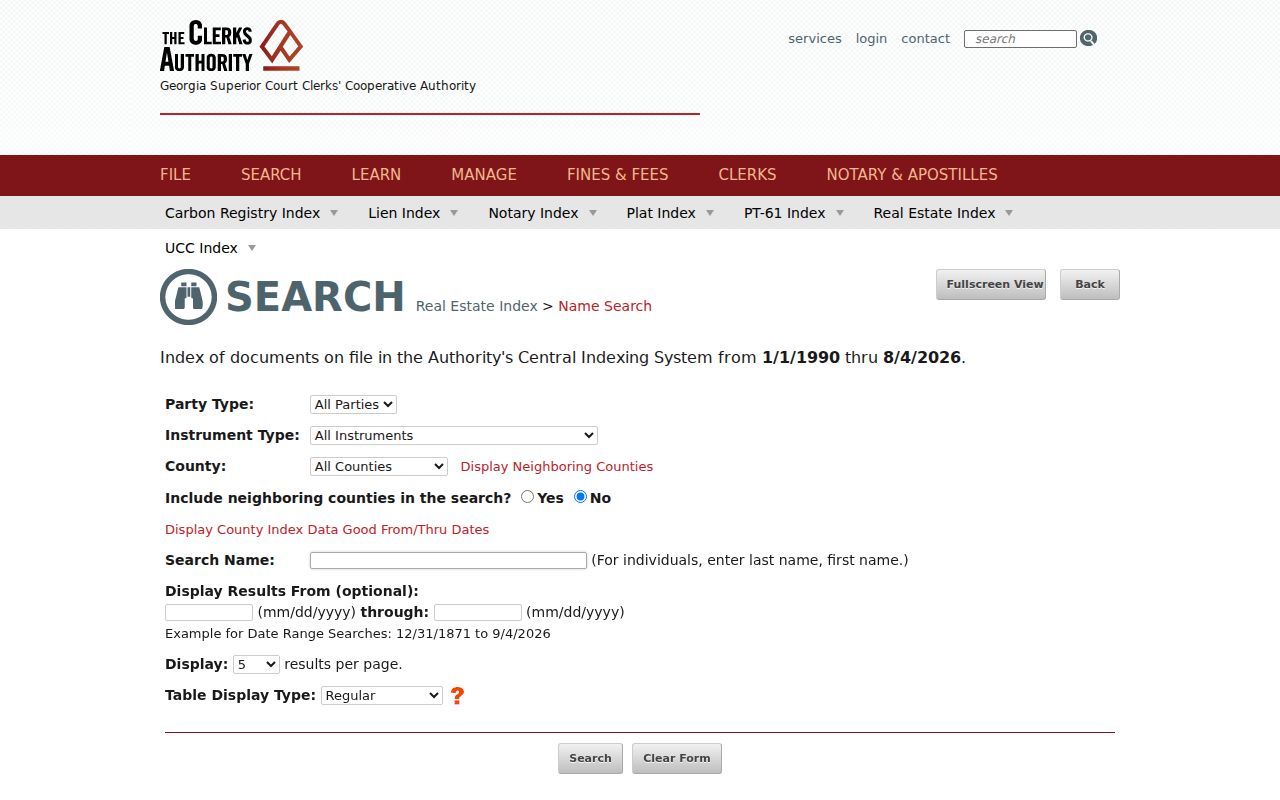
The form is statewide. Populated years and image depth vary by county, so Pike results depend on the live index. GSCCCA places every Georgia county in its real-estate index from January 1, 1999, with 1993 through 1998 data still being added.
Narrow Pike Deed Results
Filter party role and instrument type first. Neighboring counties help with county-line tracts. They also add false matches, so keep names exactly as indexed, initials and entity suffixes included.
| Field | Best use | Caution |
|---|---|---|
| Party type | Separate grantor and grantee roles | Run both for a complete chain |
| Instrument type | Limit the document category | Do not omit corrections or estate deeds |
| Date range | Bracket a known transfer | Recording and execution dates can differ |
| Book/page | Retrieve a known citation | Select Pike County first |
The captured book-page form is the precise route after another record supplies a citation.
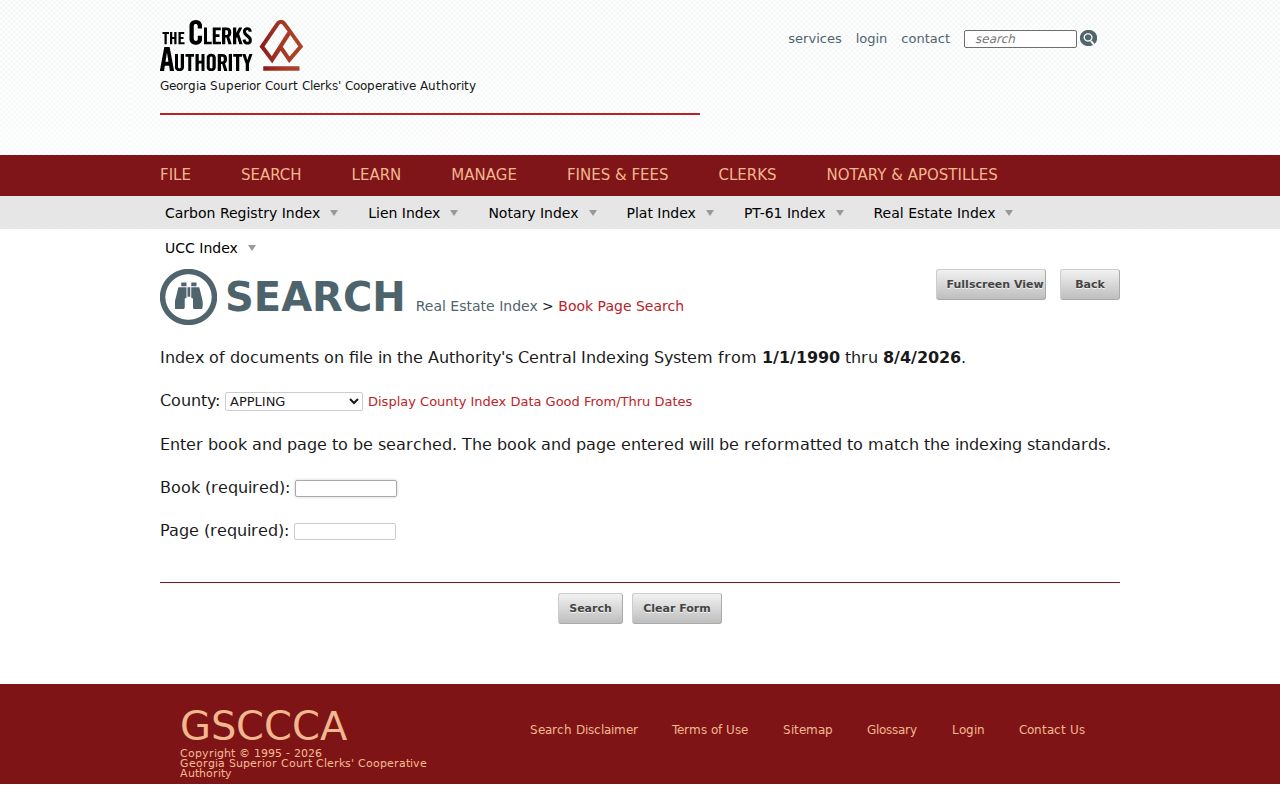
The official index screen shows why book and page matter as retrieval keys. Keep the index entry either way.
Pike Plats and Easements
The GSCCCA plat index offers both name and book-page searches. A recorded plat can show lots, roads, easements, dedications, and the layout of a subdivision. Check later amendments or vacations before relying on it.
Pike deeds use several description styles. Lot and block, land lot and district, metes and bounds, adjoining owners, roads, streams, or a prior-deed reference may all appear. Match details before treating same-name results as one parcel.
Older Pike Land Records
Pike County dates to 1822. Zebulon became the county seat in 1825. The county's first deed-book designation and its earliest online year are not published. When the online chain stops, the Clerk, the Georgia Archives, and FamilySearch's county collections carry the work forward.
Historic deeds describe land differently. Older downtown entries may cite the courthouse square, adjoining merchants, or vanished structures instead of a street number. Williamson records also lean on Driver or Stearnsville, place names tied to the 1887 railroad crossing. Such clues point the way. They never prove title.
Monitor Future Pike Filings
The GSCCCA FANS service sends free alerts when a new recorded filing matches registered criteria. Registration lasts one year. The service looks forward only. It cannot replace a past deed search, a fraud investigation, or a title review. An alert is a prompt. Inspect the official filing, then confirm parties, legal description, instrument number, and recording date with the Clerk.
Compare Pike PT-61 Filings
The GSCCCA PT-61 search takes buyer or seller name, party category, county, and date filters. A matching declaration corroborates a reported transfer. It can lead back to its deed. Still, PT-61 is a cross-check, not a substitute. It lacks the deed's legal description, and its transaction amount is not the assessor's market value.
Note the role and filing date. Add the county and any linked recording reference, since nominal consideration, exempt transactions, entity transfers, and multi-parcel deals can all bend the figures. Compare the source labels rather than collapsing them into one sale-price statement.
Get a Pike Deed Copy
Request images through GSCCCA when available. Otherwise contact Pike Superior Court at 16001 Barnesville Street, PO Box 10, Zebulon, GA 30295, or call 770-567-2000. The office states that public inspection and copying run Monday through Friday, 8:00 a.m. to 5:00 p.m. Check the cost schedule first for any image or certification fee.
The Clerk requires e-filing for real-estate documents. That rule binds submitters, not the public. No one needs a vendor account just to inspect a recorded deed. Supply county, parties, and book/page. A focused Georgia Open Records Act request may seek an existing record, though the office need not compile a title chain.
Recorded, not guaranteed. Pike County deed records show what reached the public record. They are not a title opinion, and unrecorded interests or defects may remain.
Bring in a Georgia attorney or title professional whenever ownership is disputed. The same goes for priority, enforceability, or a boundary dispute. The Pike Clerk also keeps lien, UCC, plat, and related property indexes through GSCCCA. If a deed mentions an easement, security deed, release, or earlier instrument, pull those linked records as well. A full document set often settles what one deed alone leaves muddy.
Copies are also available by visiting the office and inspecting in person. For a mail request, describe the record as precisely as you can. Ask the Clerk to confirm the current delivery method and charge before payment goes out. Electronic certification runs through Georgia's eCert system, which the Clerk links to. An index printout helps locate an instrument. Only the official copy you order carries the custodian's certification.
Check both execution and filing dates on a recent recording. For an older book, keep archive collection details. Also note whether your source was an index, transcription, microfilm image, or clerk-certified copy. That trail lets another researcher repeat the search without assuming an online index is complete. Office inspection can also surface marginal notes, stamps, cross-references, and recording data that a brief search result skips. Copy those markings exactly. When an image is faint or the index spelling differs from the document, keep both forms. Label which came from the index and which from the recorded page.
A deed chain that runs into probate opens another door. The Pike Probate Court estate file can explain an executor, administrator, or heir transfer. The court dates its records to 1823, and most are open to public research during office hours. The estate file gives context. The recorded deed remains the conveyance record. Keep the probate case citation beside the deed reference so the authority behind the transfer stays clear.
Chains with a deed under power or a tax deed need extra care. Gather the related notices and later instruments before describing the outcome. A forced-sale instrument can be recorded while redemption, confirmation, possession, or another title question is still open. The Superior Court civil file, Tax Commissioner material, and recorded releases may each hold a piece of that history. Each source can differ from the others.
Read legal descriptions line by line. Compare land lot and district, subdivision and lot, and acreage. Check road or stream calls, adjoining owners, and every prior-deed reference. A parcel number works well for tax matching but may have shifted after a split or consolidation. Two deeds sharing a party name but describing different land belong to different chains.
Georgia Archives material may be indexed by collection or image rather than party name. Start from the last reliable modern citation and work backward through book indexes. The Georgia Virtual Vault's Pike County Marriage Book covering 1832 through 1840 shows the county's surviving early record context. It is not a deed book, though. Marriage and probate records can explain surname changes or estate authority. Even so, each ownership step still needs its own land instrument.
For mail or counter retrieval, include alternate party spellings and a narrow recording span. Lead with the book-page or instrument number when you have it. Ask whether the response is an ordinary reproduction or a certified copy. That distinction matters when the document will support a court, estate, boundary, or purchase inquiry.