
Find Out Who Owns a Pike County Property
Finding an owner works best in a fixed order. Begin at the Pike property and tax search. Its visible controls include Tax Year, Search Type, Search Terms, and Subdivision. Result cards display their own labels, so copy only the fields the live card actually shows.
- Search the situs address and capture the parcel or map number and tax-roll owner.
- Search that owner in Pike County through GSCCCA and locate the newest matching deed.
- Compare the deed's legal description, dates, grantee, and book/page or instrument number.
- When the grantee is a business, check its exact registered name in Georgia's business search.
Start With Pike County's Tax-Roll Owner
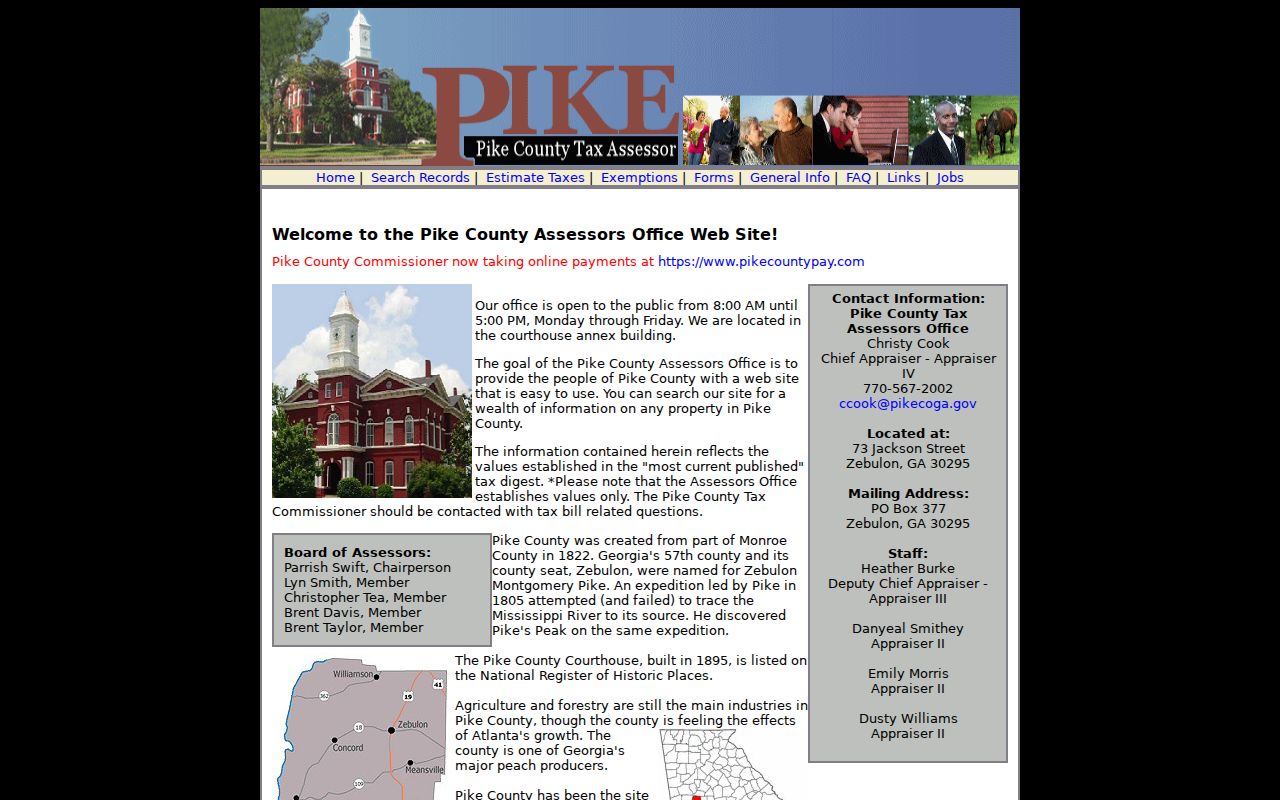
The Pike County Assessor keeps the digest, assessments, maps, appeals, and exemptions. The office's page links to qPublic, and the county-associated Altags page offers another property-search entry. Try the address first. If street spelling or highway naming throws off the search, switch to the parcel number. Owner-name and subdivision searches give you two more paths in. Write down the tax year or source date. Georgia counties review property annually, though Pike County publishes no fixed online refresh interval. The tax roll answers "who owns" fastest. Even so, a just-recorded transfer can outrun the next update. The Pike qPublic link listed by Georgia DOR leads the way. It lands on the county's official parcel search page.
Parcel cards differ from county to county. Read the owner, mailing, value, deed, and update labels live on the qPublic page rather than filling gaps from another county's system.
Confirm Who Owns It in the Pike Deed Index
The GSCCCA real-estate name search covers party type, instrument type, county, a neighboring-county option, search name, dates, result count, and table controls. Individuals go in as last name, first name. Search the assessor's owner as a grantee. Then match the newest instrument against the parcel's legal description before trusting it.
| Check | Why it matters |
|---|---|
| Grantee | Names the recipient in the conveyance |
| Recording date | Places the document in the public index |
| Book/page or instrument | Provides the retrieval key |
| Legal description | Connects the deed to the land, not just a name |
The Pike Clerk Real Estate/Property Division receives recorded land records. It reproduces them. It also opens them to any member of the public for inspection and copying. The e-filing vendors that professional filers use are not needed for this kind of search. Bring a parcel number or deed date. The staff can pull the right record fast.
Note: A common name without matching land details is a lead, not a confirmed Pike County property owner.
Where Pike County Ownership Appears
Three official record systems can carry owner facts, but they differ in weight and timing. Use the source table to decide which facts to collect and which date to keep.
| Source | Owner Info It Gives | Access |
|---|---|---|
| Assessor tax roll | Tax-year owner, parcel key, situs and mailing clues | Tied to the displayed roll year; refresh interval unverified |
| Clerk and GSCCCA deed index | Grantor, grantee, recording reference and instrument | Newest matching recorded conveyance |
| Assessor or GIS map | Parcel geography and map number | Current only as of its stated map date |
| Georgia business search | Entity registration and agent details | Entity status, not land title |
An occupant is not an ownership record. A mailing city or ZIP cannot establish whether land sits inside Zebulon, Williamson, Concord, or unincorporated Pike County either. When location matters, rely on the parcel record and the current boundary source.
Resolve LLC, Trust, and Estate Ownership in Pike County
A deed sometimes names an LLC, corporation, trust, or estate instead of a person. For a company grantee, search the exact name with the Georgia Corporations Division. Its fields cover business name, control number, registered agent, officer, and designated agent. You can match by starts-with, contains, or exact. That search identifies the organization behind the name but does not prove title. Trusts may shield beneficiaries. Estate names can point to probate administration. Pike Probate Court holds records back to 1823. Most are open for research during office hours. Use probate to sort out authority or succession. Then return to the recorded land instrument for the definitive answer.
Recent Transfers Can Split the Pike County Answer
After a recent sale, record two owners and two dates. One is the assessor's owner. The other is the latest deed's grantee. The GSCCCA PT-61 search adds a buyer-or-seller transfer cross-check. A PT-61 documents the sale event. It does not replace the deed or settle who owns the parcel. Parcel splits create a second mismatch risk. A deed may describe the parent tract while the assessor shows a new map number. Pull correction deeds, plats, easements, and any referenced prior deeds. If the legal descriptions diverge, ask the Assessor for the existing parcel relationship. GIS staff can help too.
Use the Pike County Clerk When Portals Fail
The Clerk's office sits at 16001 Barnesville Street in Zebulon, open Monday through Friday, 8:00 a.m. to 5:00 p.m. Its property division keeps records open for public inspection and copying. Bring the owner name, the parcel number, and any book or page reference. Ask for an existing index entry or instrument. Staff will not build a title chain for you. For an existing assessor record, a focused request under the Georgia Open Records Act can surface the situs, parcel number, record category, and date range. State guidance allows an initial response within three business days. Reasonable retrieval and copy charges may apply. The law does not force an agency to create a new report. Note: Confirm the current copy charge before ordering, since no deed-specific amount is published.
Match the Pike County Legal Description
A name alone proves little. In Pike County, the assessor parcel and the deed must describe the same tract of land. Only then is an owner of record settled. Set the two documents side by side. Compare the subdivision, lot and block, land lot and district, acreage, metes-and-bounds calls, and any prior-deed references. A street address is only a search key. The land's legal identity lives in the description, not the mailing label. Watch for highway abbreviations and mailing-city names that shift between systems. Splits complicate things. A parcel was sometimes carved from a parent tract. The current card may carry a map number that the older deed never mentions. Chase the paper instead of guessing: search plats, correction deeds, easements, rights-of-way, lot combinations, and earlier conveyances until the chain closes. If descriptions still conflict, ask Assessor or GIS staff whether a parcel-relationship record already exists. Say so plainly when the match stays uncertain. Attaching a deed from a similarly named owner is worse than admitting doubt.
Use Pike County's Offline Owner Routes
Pike County keeps its land records open for inspection and copying. The Clerk's office sits at 16001 Barnesville Street in Zebulon, weekdays from 8:00 a.m. to 5:00 p.m. Bring a book and page, and staff can pull that instrument. The Assessor at 73 Jackson Street handles requests for an existing parcel card or map. A focused Georgia Open Records Act request works well when you know what you want. Name the parcel, the record category, and the date range. State guidance allows reasonable retrieval and copy charges. It also generally expects an initial response within three business days. Remember that the agency does not have to build an ownership analysis for you. Ask instead for an existing card, map, deed reference, or file. The request then stays on solid ground.
Limits of a Pike County Ownership Lookup
Document your match. Save the tax year and portal access date alongside the assessor name. Then save execution and recording dates alongside the deed. If a transfer falls close to the assessment date, report the timing. Note whether the match came from a situs, owner, parcel, subdivision, or book/page search. A dated trail is repeatable. That beats a bare claim that a person or entity owns the land. The tax roll and an index summary both hide what was never recorded. Competing deeds, legal-description gaps, or title defects call for a qualified title professional. That professional can examine the record chain and the applicable law. Keep a screenshot or certified copy when the stakes justify it. Label whether an image, summary, or office copy supplied each fact. Know the ceiling. A public result can name the tax-roll owner or recorded grantee. It cannot guarantee unrecorded interests, resolve every lien, or say who occupies the land. A map line is not a survey. A business filing is not a deed. A portal summary is not a certified instrument. For detail on the present owner, use the Pike County current owner record guide.
Lawful use. A Pike County owner lookup supports purchase diligence, boundary questions, estate work, and civic research. Never use public data to watch, threaten, or harass anyone.