
Trace Pike County Former Owners Backward
Work from the newest matching deed backward. Skip loose name lists. The GSCCCA name search offers party type, instrument type, county, name, optional dates, and display controls, which keeps a Pike County property search tight. Log every transfer in one format so missing links stand out.
| Source | Years It Covers | Where Held | What It Shows |
|---|---|---|---|
| Newest transfer date | Grantor to grantee | Deed type | Book/page or instrument |
| Prior transfer date | Earlier grantor to later seller | Warranty, quitclaim, executor, or other deed | Referenced book/page |
| Earlier book entry | Names exactly as indexed | Recorded land instrument | Clerk, archive, or microfilm citation |
Keep execution and recording dates separate. They rarely match. Add the legal-description type, prior-deed reference, and any correction, release, easement, or plat affecting the tract, because a security deed can encumber land without changing fee ownership.
The GSCCCA grantor and grantee form is the online starting point for tracing Pike County former owners.
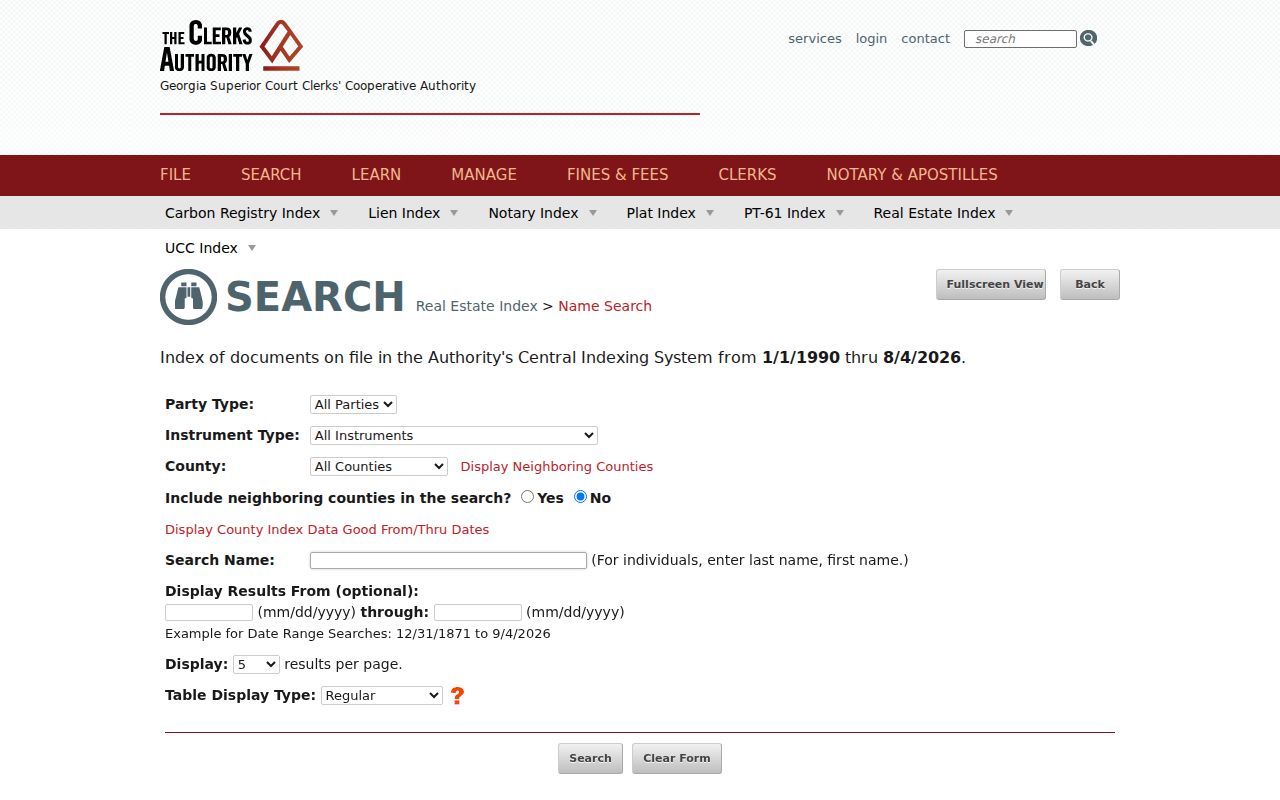
Its party, instrument, county, name, and date controls support the repeated backward search through the deed records. The deed itself supplies the land match.
Pike County's 1999 Online Baseline
The GSCCCA real-estate system states that its index covers every Georgia county from January 1, 1999 forward, with 1993 through 1998 data and images being added. Treat that baseline as the dependable online point. It is not a verified earliest Pike County entry. Confirm actual Pike County coverage in the portal or with the Clerk before trusting the property records you pull.
The exact Pike County deed-book series and earliest populated online year remain uncertain. A blank result proves nothing. A former owner or deed may still exist on paper.
Coverage limit. Online indexing has a modern baseline. Earlier Pike County former owners may be in courthouse books, microfilm, or archives.
Match Pike County Land, Not Just Names
Common names create false chains fast. So do initials, remarriage, estates, and business-name changes. Match the land itself: lot and block, subdivision, land lot and district, metes-and-bounds calls, acreage, adjoining owners, and prior-deed references. When a deed supplies an exact citation, the GSCCCA book/page search is the best route.
Parcel splits add another trap. The new assessor number can lose touch with the parent tract described in older deeds. Search correction deeds, plats, easements, and consolidation records. Note every map number that appeared over time.
Note: A street-address match alone is too weak for a historical Pike County ownership chain.
Walk the Pike County Deed Chain in Reverse
Each seller becomes the subject of the next search. The method repeats cleanly. Judgment still matters when one deed covers several tracts or shifts the legal description.
- Find the current acquisition deed and copy the grantee, grantor, dates, and land description.
- Search the grantor as an earlier grantee and locate the instrument by which that party acquired the same tract.
- Repeat while the descriptions and prior references remain consistent.
- At the online limit, continue with the Clerk, Georgia Archives, or deed-book images.
- Grantor and grantee
- The conveying party and the receiving party.
- Chain of title
- The ordered sequence of instruments affecting ownership.
- Reverse index
- An index organized around the grantor side of a transaction.
- Quitclaim and warranty deed
- Different forms of conveyance that must be read as recorded, without assuming what title quality they establish.
Plats Keep Pike County Lots in Context
The GSCCCA plat index offers name and book/page searching for county-submitted indexes from January 1, 2004. A recorded plat ties together a lot number, road, easement, dedication, subdivision name, and later deed reference. No county plan or zoning map replaces it. Search owner, developer, surveyor, and subdivision names. Then check for later plats. Did they amend, vacate, split, or consolidate the property?
Pike County Probate Can Explain a Broken Chain
Not every change of ownership in Pike County traces to a sale. A death can move land through an executor. It can also move land through an administrator, an heir, or a later estate deed. The Pike Probate Court holds records reaching back to 1823. Most are open for public research during office hours. A probate file shows who had authority to act. The land chain still depends on the deed or other recorded instrument.
Search beyond warranty deeds. Executor and administrator deeds, deeds under power, tax deeds, and correction deeds all matter. Each of these appears in Pike County property records. Note the capacity in which each signer acted. That detail often explains a broken link.
An 1830s Pike County Name-Clue Collection
Early Pike County deeds can blur families together. The Georgia Virtual Vault preserves Pike County Marriage Book 1832-1840 as an indexed digital object, microfilm 2276. It is not a deed register. Use a marriage entry only as a name clue. A spouse match can separate men who share a surname when early property records repeat names and initials. Before tying anyone to a parcel, return to the deed's legal description and an exact archive or book citation.
Include Every Pike County Conveyance Type
Chains break for surprising reasons. A searcher who pulls only warranty deeds misses the quitclaims, executor deeds, deeds under power, tax deeds, and correction deeds that fill Pike County deed records. Each instrument type does different work. A correction repairs a name, a release cancels an encumbrance, and a plat divides a parent tract. Easements change access without moving fee ownership. Security deeds encumber land the same way. Neither makes the lender or utility holder an owner of record, so log each item by its function rather than stacking every indexed entry into the ownership timeline.
Carry Pike County History Across Address Changes
Old Pike County instruments rarely cite a modern street address. A settlement, creek, road, adjoining owner, courthouse, or railroad feature often stands in for the situs instead. White Oak Creek can guide an old Concord search. Driver and Stearnsville work as Williamson-area clues. The legal description stays the anchor. When acreage, land lot, district, or adjoining calls shift, expect a split, consolidation, correction, easement, or new plat. Keep the original wording intact, test normalized road forms, and never erase lot or directional details, because a chain built on street text alone can jump between tracts.
Search Pike County Names With Care
GSCCAA asks for last name first, then first name, when you search an individual. Pike County must stay selected while you work. Try initials and suffixes, and vary entity spellings across narrow date ranges. A neighboring-county deed belongs in your chain under one condition only. Its legal description or prior reference must match the land in question.
Marriage and probate files can separate men who share a name. They are identity clues, not conveyances. Cite them separately. Then go back to the deed book, the page, and the land description before you name any former owner.
How Far Pike County Ownership Records Reach
Preserve everything for each link you add. That means instrument type, number, recording and execution dates, grantor, grantee, book and page. Include legal-description form, prior-deed reference, and the route to the image. Add a confidence note when a common name leaves room for doubt. Do the same when a changed description does. This record-by-record citation keeps a tax name, a probate clue, or a historical index entry apart. Each stays distinct from a completed conveyance. Keep findings and conclusions separate in your research log, especially where no image appears online.
Pike County dates to 1822, and the Probate Court reports records from 1823. That is deep local record history. It does not prove every deed series survives, is indexed, or sits online. Georgia Archives guidance notes that many pre-1900 county records can be reached through the Virtual Vault, FamilySearch, or microfilm. Some lack name searching, though. That limit matters when you are tracing an owner of record across generations.
When the chain stops, gather the last reliable book and page. Add the legal description and the names. Take them to the Pike Clerk's property division. Ask for the index or book covering that period. A title professional may be needed where gaps or competing conveyances come into play. Legal interpretation may also call for one. Log every record you check.
Lawful use. Former-owner research supports house history, estate work, and property diligence. Never use a historical chain to track or harass a living person.